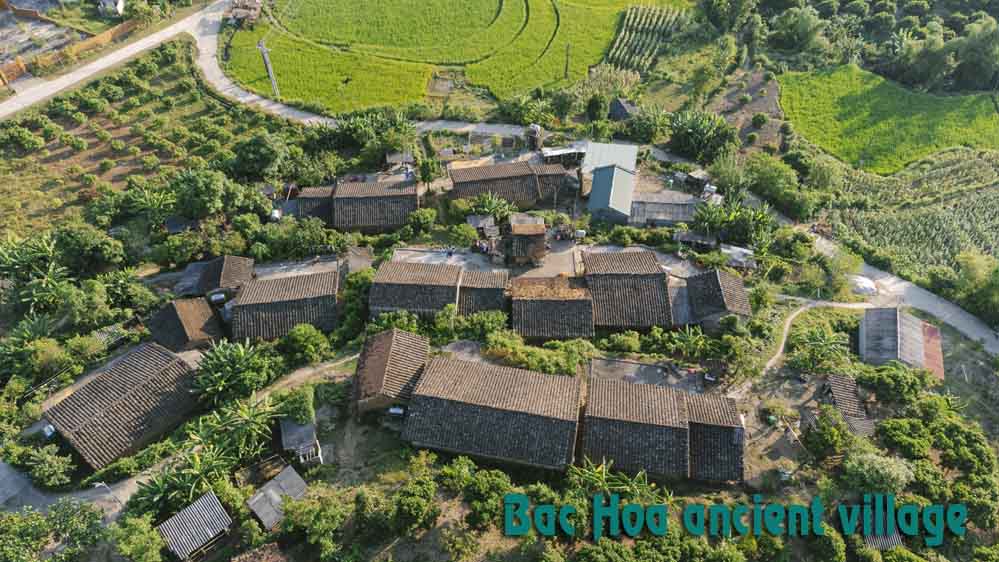
Asiatica Travel - Bac Hoa, the name of a beautiful village, is the first impression of a land that further attracts travelers from afar. Bac Hoa belongs to Tan Son commune, Luc Ngan district, Bac Giang province - a place where small houses with earthen walls and charming yin-yang tiled roofs nestle against the lush green hillsides, belonging to the Nung ethnic people.
The journey from Bac Giang city to Bac Hoa takes about an hour by car. The route from Bac Giang city to Bac Hoa via the Tay Yen Tu spiritual route is quite convenient (except for the currently degraded section of Highway 31). After arriving at Chu town, continue on Highway 31 to the Kep intersection in Hong Giang commune, then turn onto Provincial Road 290, travel about 15km, and then continue for about 7km on Highway 279, the section connecting Bac Giang to Dinh Lap district in Lang Son province. Passing through the center of Tan Son commune, Luc Ngan district – where the Tan Son love market is held annually – turn off Highway 279 and travel about 2km on the paved road to reach Bac Hoa.
Bac Hoa is as beautiful as a mountain girl, simple, rustic, and poetic… Along the road are lush green hills, with houses hidden among rolling hills of lychee trees. Standing out against the verdant hills are the houses with their yin-yang tiled roofs, leaving a lasting impression on those who have the chance to visit Bac Hoa. Right along the main road into the village are rows of ancient houses with earthen walls, making everyone want to stop and admire them. Seventeen families live here, mostly relatives, forming a small hamlet. The houses are almost seamlessly connected; you can step directly from one house to another, or the boundaries are only marked by shared pathways, hedges of trees and stacked stones, or patches of wildflowers… All 17 families here still maintain the traditional style of earthen-walled houses with yin-yang tiled roofs, evoking a connection between the present and the past.
Beside the traditional earthen house, Mrs. Vi Thi Them, an 80-year-old woman from the village, still sits by her loom weaving indigo-dyed scarves to sell to her ethnic group for use during spring festivals… This image evokes the idea that traditional cultural values will endure through time. In Bac Hoa, there is also a Slong Hao singing club with over 30 members. Mr. Lang Quoc Ky, the vice chairman of the club, said that the club still holds activities and exchanges, and every year, in the first two months of the year, the club members dress up in their traditional costumes and go to Tan Son market to participate in the singing festival, preserving the culture of their ancestors.
The entire Bac Hoa village has over 160 households, 100% of whom are Nung people. The villagers live scattered across the hillsides, cultivating agriculture, growing fruit trees, and a small area of rice and short-term vegetable crops. The lives of the villagers have gradually improved over the years, but traditional culture has faded somewhat. In recent years, there has been increased awareness of preserving traditional culture. The village now has a Slong Hao singing club, and the teaching of folk songs has become more conscious among the villagers. During spring festivals, the sight of people wearing indigo shirts and scarves at the market creates a unique atmosphere of the highland market. The traditional houses with yin-yang tiled roofs are also preserved by the villagers.
Mr. Vi Van Cheo, head of Bac Hoa village, said: "Recently, Bac Hoa has received many visitors, including researchers exploring the culture and tourists who appreciate the scenery and people of Bac Hoa. Most visitors share the same feeling about Bac Hoa's beauty and hospitality. Tourists are quite interested in the tour experiencing the fruit orchards, the traditional Chu noodle production village, and Bac Hoa. However, the services here are not yet diverse, so visitors can only come for a day trip and there are no services for overnight stays. This is also a concern for the tourism industry in Bac Giang and Luc Ngan district..."
To attract tourists to Bac Hoa and other potential destinations in Luc Ngan, comprehensive investment in infrastructure, accommodation, and accompanying tourism products and services is essential. Simultaneously, a strategy to enhance the image and promotion of these destinations is needed so that Luc Ngan in general, and Bac Hoa in particular, become widely known to tourists.

No comments:
Post a Comment
Note: Only a member of this blog may post a comment.